This is the second key article in a series that looks at the Manufacturing module in Jiwa 7.
Before proceeding please ensure that you have reviewed our article Jiwa Manufacturing - Bill of Materials
Overview
A Work Order also referred to as a production order or manufacturing requisition is used to produce a finished product or a component that is used in another manufactured item.
In this article we look at how to create a Work Order based on a Bill of Material.
Advanced functions and features are covered in separate articles this includes;
-
Production Areas and Lines,
-
Work centres, and
-
Sub-assemblies
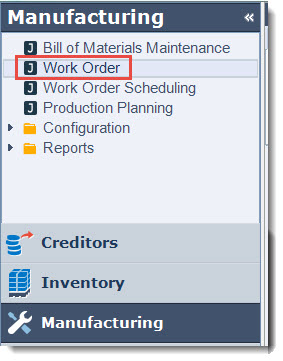
From the menu select Manufacturing | Work Order
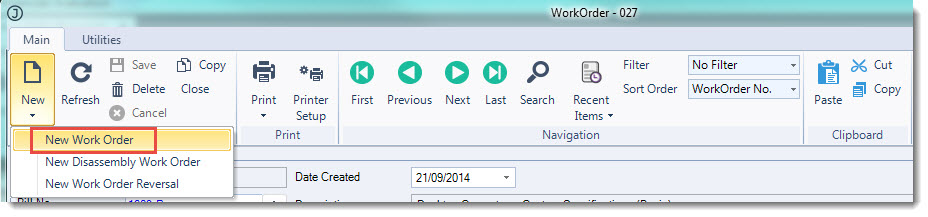
From the menu ribbon select New Work Order
Header Information
The General section of the form provides details relating to the overall Work Order.
Select the Bill of Material to be used by clicking on the lookup icon next to the Bill No. field to bring up the Bill of Material Search form and select the required Bill.
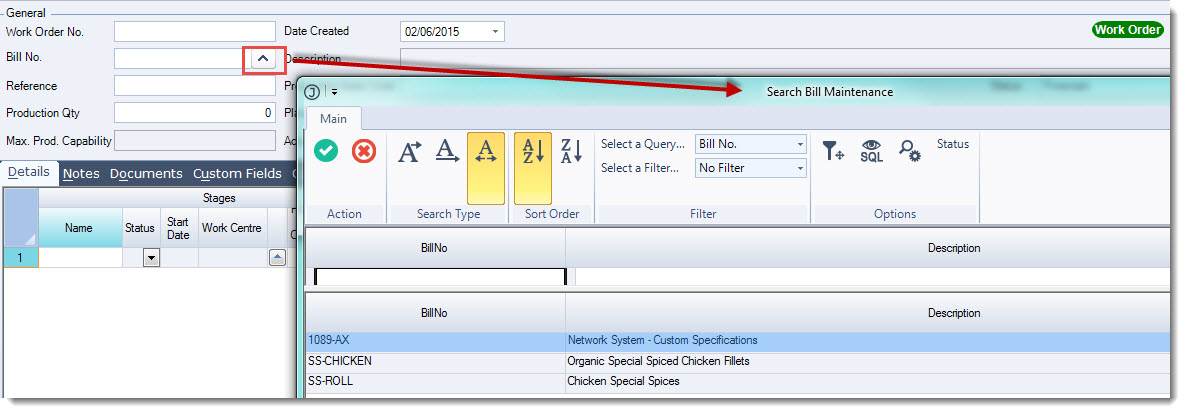
Enter in the quantity of items to be produced in the Production Qty field

Set your planned production dates and work order status


|
Field |
Description |
|
Work Order No |
This field will be automatically updated with the next available work order number on the first save |
|
Date Created |
This field will default to the user login date but can be changed manually if required |
|
Bill No. |
The Bill of Material number that is linked to the work order |
|
Description |
The Bill of Material description from Bill maintenance |
|
Reference |
Additional reference field |
|
Production Area / Line |
This field is automatically updated from Bill maintenance but can be manually overridden. This field is not mandatory and if production areas are not being used can be left blank |
|
Production Qty |
The quantity to be produced (manufactured) is entered in this field |
|
Planned Prod. Date |
Planned production date. This date is only a reference and is not used by Jiwa |
|
Required By |
Date that the output items are required by. This date is only a reference and is not used by Jiwa |
|
Max. Prod. Capability |
This is the maximum number of output items that can be produced at the time the Work Order is created based on the quantities of input items that are available. This field is recalculated with the movement in your input items. |
|
Actual Prod. Date |
The actual date that the Work Order has gone into production. This date is only a reference and is not used by Jiwa |
|
Completed Date |
The actual production completion date. This date is only a reference and is not used by Jiwa |
|
Status |
Work order status
|
|
Parent Work Order |
This field is automatically populated with the parent work order if the current work order is a sub-assembly |
Details Tab
The Work Order Details tab has a similar layout to the Bill of Material Details tab with 3 key areas;
-
Stages
-
Inputs
-
Outputs
This tab is automatically populated from the Bill of Material that is loaded into the Work Order however this information may be changed at the Work Order level if required.
Stages
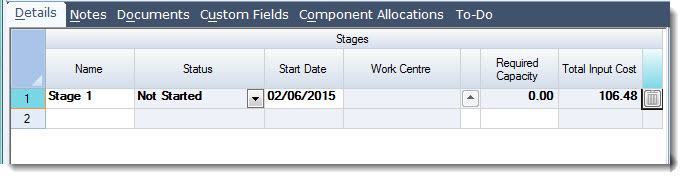
Confirm your stage start date
|
Field |
Description |
|
Name |
Stage name Your Bill of Material must have at least 1 stage |
|
Status |
The status field is not editable when the Work Order status is set to Not Started When the Work Order Status is changed to Started the stage status field is updated to In Progress and the field is enabled. If required the stage can then be set back to Not Started.
|
|
Start Date |
Stage start date. This field will default to the user login date |
|
Work Centre |
This field is not mandatory and can be left blank if this feature is not being used. Work centres are covered in more detail in separate articles. The field will automatically be populated from the Bill of Material if Work Centres are being used. |
|
Required Capacity |
This field is only enabled when a Work Centre is selected and represents the time required to complete the stage for a single unit. This field is greyed out when a work centre is not selected |
|
Total Input Cost |
This is the total cost of the stage based on the stage inputs |
Inputs
Components
Adjust your inputs as required by adding lines, removing lines, adjusting quantities, changing the explode policy.

|
Field |
Description |
|
Part No. |
Input item part number |
|
Description |
Part number description |
|
Sub-assembly |
The related sub-assembly if the input item is one that is manufactured. The sub-assembly can be changed if required on the work order by clicking on the lookup icon next to the field to view all available sub-assemblies. |
|
Explode Policy |
The Explode Policy controls when the works order is created for the sub-assembly, this can be changed if required on the Work Order.
|
|
Quantity Type |
Controls how input items are consumed in a Work Order
|
|
Unit Quantity |
Quantity used per unit |
|
Total Quantity |
Unit Quantity x Production Qty |
|
SOH On Shelf |
Total stock on hand in the active warehouse |
|
SOH Available |
Total stock available in the active warehouse |
|
Quantity Taken |
Actual quantity used in the production process. This field is automatically updated with the Total Quantity when the Work Order status is changed to Started but can be changed if required |
|
Quantity SubAssembly |
Actual sub-assembly quantity used in the production process This field is automatically updated with the Total Quantity when the Work Order status is changed to Started but can be changed if required |
|
Quantity on Backorder |
Quantity on back order |
|
Quantity Wastage |
Quantity wasted during the production process |
|
Last Cost |
Last cost from Inventory maintenance |
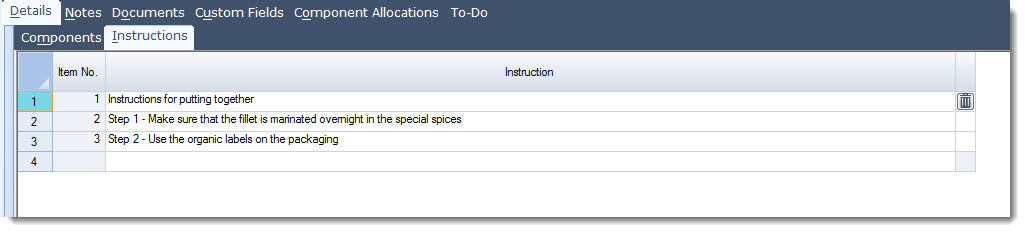
Instructions
Add or update your stage instructions
Outputs
Confirm your output item details.

|
Field |
Description |
|
Part No. |
Input item part number |
|
Description |
Part number description |
|
Quantity Type |
Controls how output items are created in a Work Order
|
|
Unit Quantity |
Output quantity from Bill of Materials |
|
Total Quantity Expected |
Unit Quantity x Production Qty |
|
Quantity WIP |
Finished quantity sitting in Work in Process This field is automatically updated with finished goods completed when the status of all stages on the Work Order have been updated to In Progress |
|
Quantity Output |
Actual quantity produced |
|
Quantity Written Off |
Quantity written off from the quantity produced |
|
Last Cost |
Last cost from Inventory maintenance, this is a read only field |
|
Cost |
Sum of the component costs across all stages, this is a read only field |
|
Cost Percentage |
This field is only applicable if there is more than 1 output item on the Work Order and controls how the total input costs are apportioned across the output items. |
|
Primary |
|
Select Save from the menu ribbon to create your new Work Order.
Other Tabs
|
Field |
Description |
|
Notes |
This tab allows you to enter notes that relate to the Work Order |
|
Documents |
This tab allows you to attach documents to the the Work Order |
|
Custom Fields |
This tab contains additional information that needs to be captured on a Work Order via custom fields |
|
Component Allocations |
This tab is only applicable if there is more than 1 output item on the Work Order. Inputs can be allocated to specific outputs in this tab. |
|
To Do |
This tab allows you to add tasks specific to the Work Order |
Reporting
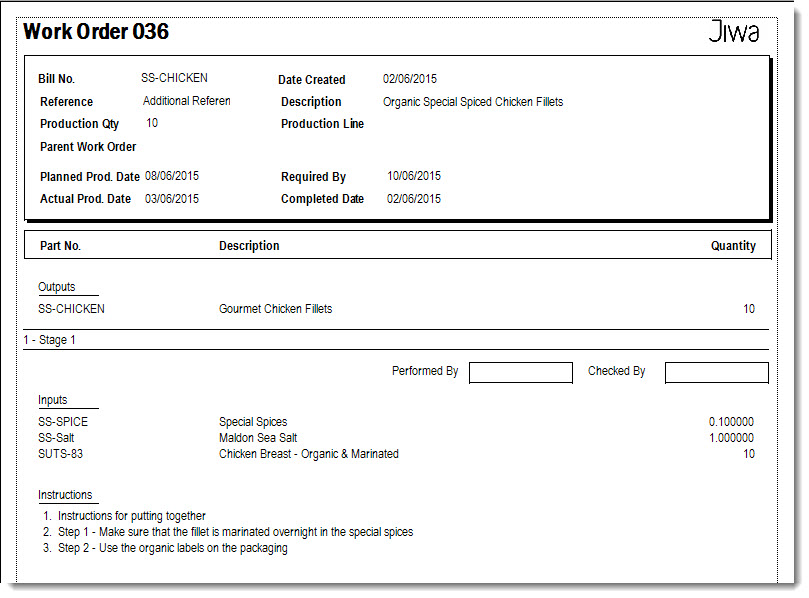
To print out the Work Order report from the menu ribbon select Print | Work Order

This video is best seen on the full screen. Just click on the icon at the bottom right of the video (see image below).
To exit full screen just press escape