
Price schemes in Jiwa control how selling prices, discounts, and promotional prices are applied during sales order entry, quote entry, and credit note entry.
A price scheme is made up of one or more price matrices, and each price matrix contains one or more pricing elements. The price scheme is linked to a Debtor account and is then used by Jiwa to determine which price or discount should apply when a product is added to a sales order, quote, or credit note.
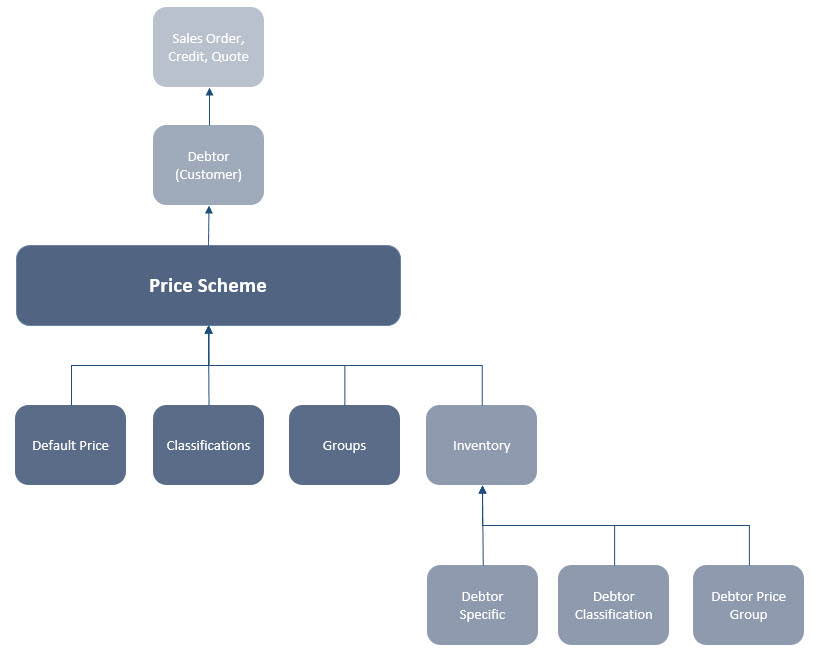
How price schemes are used
Each Debtor account is linked to a price scheme. When a sales order, quote, or credit note is created for that Debtor, Jiwa uses the linked price scheme to determine the applicable selling price.
The price scheme controls:
-
the default selling price that should apply
-
whether discounts or promotional prices are available
-
whether Jiwa should apply the cheapest available price
-
the order in which pricing elements are considered when the cheapest price is not being used
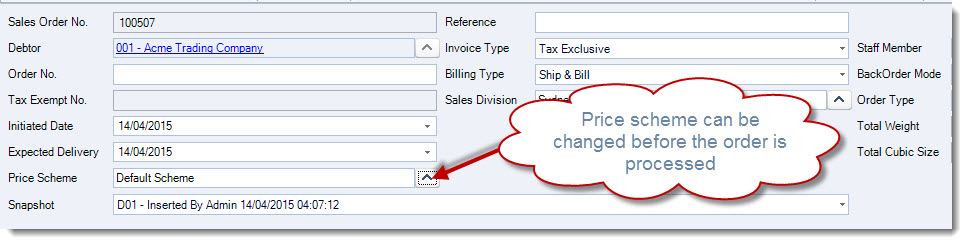
The price scheme can also be changed on a specific sales order, credit note, or quote before it has been processed.
Before creating a price scheme
Before setting up a price scheme, it is important to consider how pricing should work for the customers who will use that scheme.
|
Key decision |
What to consider |
|---|---|
|
What is the default price for the price scheme? |
The default price is the catch-all price used when no other pricing element applies. Every price scheme should have a clear default price so that Jiwa can still apply a selling price when no special pricing, discount, or promotional rule is found. |
|
What pricing elements or matrices are applicable to the scheme? |
The pricing elements included in the scheme determine which prices, discounts, or promotional rules Jiwa can consider. For example, if you want to apply special pricing for a specific Debtor Classification, the Debtor Classification matrix needs to be included in the price scheme. |
|
Should the cheapest price or best price be applied? |
If the cheapest price option is selected, Jiwa reviews the applicable prices and applies the cheapest available price. In this case, the order of pricing elements is not critical. If the cheapest price option is not selected, the order of pricing elements is important because Jiwa applies the first applicable price based on the order of the scheme. |
Example price schemes
The following examples show different ways price schemes may be structured.
|
Price scheme |
Purpose |
Example pricing elements |
Use cheapest |
|---|---|---|---|
|
Default Price Scheme |
Used where the customer should receive the best available price from all applicable pricing rules. |
|
Yes |
|
Wholesale Price Scheme |
Used where wholesale customers should receive a specific wholesale price, with selected customer-specific pricing applying first if available. In this example as the cheapest price is not applicable the order of the prices becomes critical. In this example we’re saying that;
|
|
No |
|
Distributor Price Scheme |
Used where distributors receive a specific distributor price and are not normally entitled to discounts. The cheapest price option is ticked allowing for future promotional prices to be added to the scheme if required. |
Sell Price 2 |
Yes |
Key points to remember
-
A price scheme determines which prices and discounts are considered for a customer.
-
The default price acts as the fallback price when no other pricing rule applies.
-
If the cheapest price option is used, Jiwa applies the lowest applicable price.
-
If the cheapest price option is not used, the order of the pricing elements is important.
-
Price schemes should be planned before they are created, especially where different customer groups, product groups, discounts, or promotional prices are used.