
Budget details are used in Jiwa Job Costing to record planned or approved budget values against a job.
This article explains how to add budget information to a job so that expected values can be compared with actual job costs as work progresses. Budget details can help with cost tracking, job review, and profitability reporting.
Budgets and estimates
Budgets and estimates are both used to compare expected job values with actual job activity, but they are used in different ways.
|
Area |
Purpose |
|---|---|
|
Budget |
Used to record planned or approved budget values for the job. Budgets are generally used for budget tracking, reporting, and actual vs budget comparison. |
|
Estimate |
Used to record detailed expected costs and charges for the job. Estimates can include specific inventory, labour, resource, purchase, cash book, or journal-related values. |
Budgets are useful where the business wants to track job performance against approved or planned amounts. Estimates are more detailed and are generally used where expected costs and charges need to be built up from specific job lines.
Before adding budget details, the job record should already be created in Jiwa.
Adding Budget Details
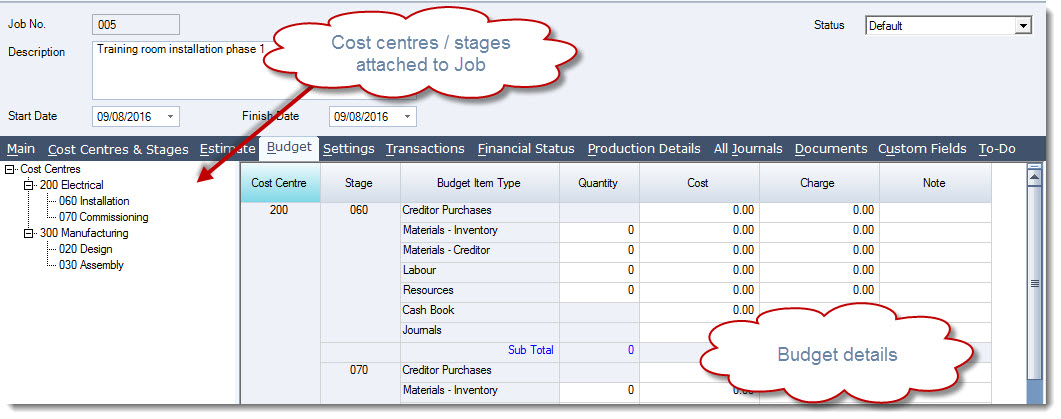
To add Budget information to your job move to the Budget tab.
The tab is divided into two(2) sections;
-
The left panel displays all the cost centres and stages that are attached to the job,
-
The right panel is where budget details are maintained by Cost Centre / Stage / Budget Item type
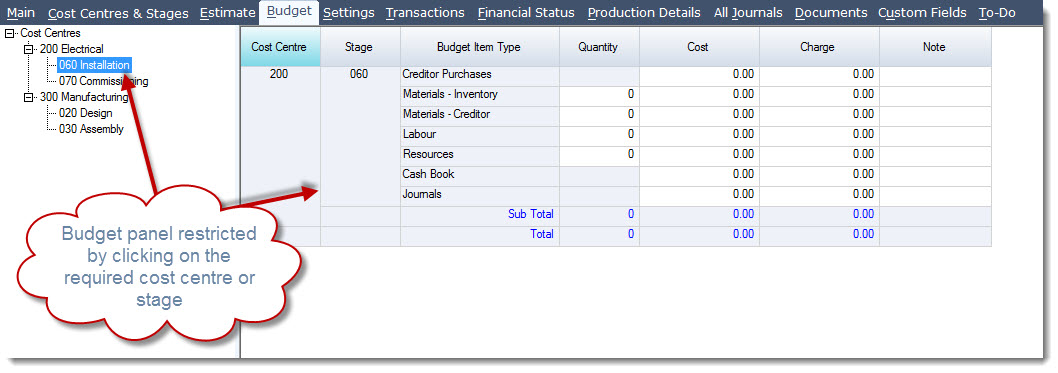
The Budget panel can be expanded or restricted by clicking on the required Cost Centre or Stage on the left hand panel
Start entering your budgeted costs in the right panel.
The Quantity field does not need to be populated but may be useful if you want to be able to compare actual quantities against budgeted quantities for example if you want to compare actual labour hours to budgeted hours.
The Charge field is automatically populated based on your markup percentages on the Settings tab. If the markup settings are changed the charge amounts are recalculated.
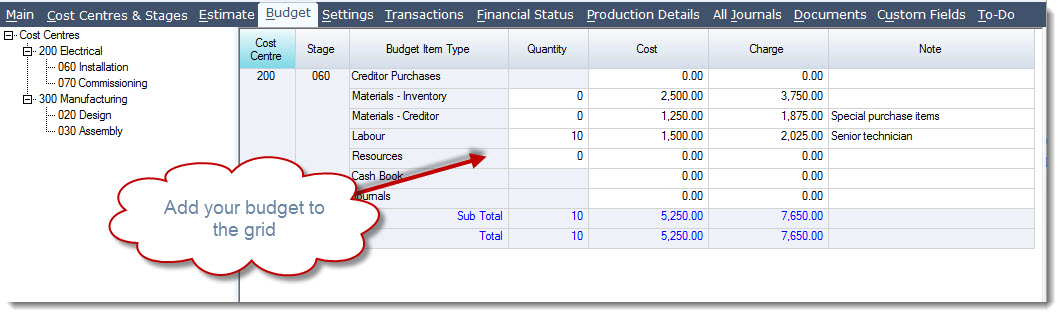
Repeat the process for each Cost Centre and don't forget to Save as you work through your budget.
|
Field |
Description |
|
Cost Centre |
Cost centre code that the budget is applicable to |
|
Stage |
Stage code that the budget is applicable to |
|
Budget Item Type |
There are seven(7) different budget types that values can be added against. Each type representing different transaction types that are added to jobs.
|
|
Quantity |
This is an optional field |
|
Cost |
Budgeted costs |
|
Charge |
This field is manually calculated based on the markup percentages on the Settings tab |
|
Note |
Note field for user comments |
Financials Tab
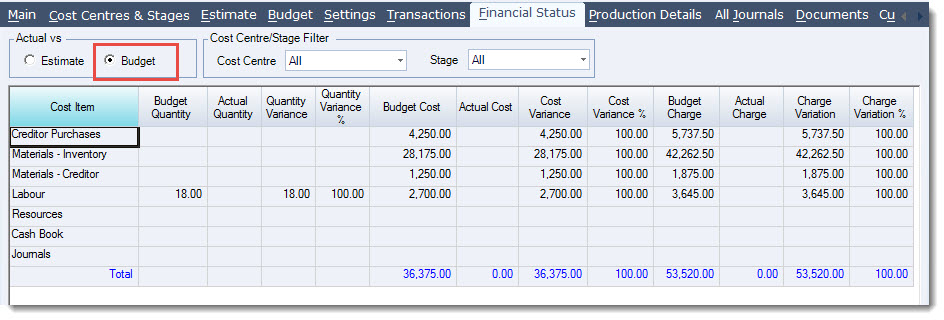
On the Financials Tab actual costs and charges can then be compared to the budget by selecting the Budget radio button
Video walkthrough